Svix vs Hookdeck vs Convoy vs ThunderHooks: Webhook Delivery Compared (2026)
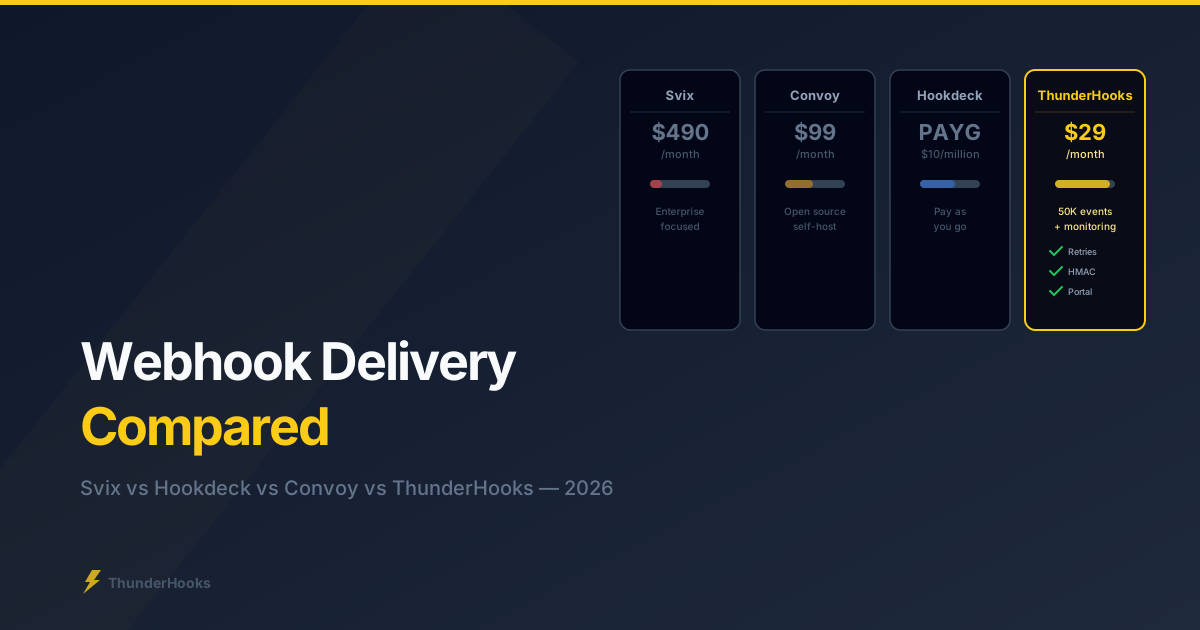
Svix vs Hookdeck vs Convoy vs ThunderHooks: Webhook Delivery Compared
You need to send webhooks reliably, or receive them and route them somewhere useful. Four platforms keep showing up in search results: Svix, Hookdeck, Convoy, and ThunderHooks.
They all solve webhook problems. They don't all solve the same ones, and they don't all cost the same. This is a straightforward comparison based on current pricing, actual feature sets, and who each tool is built for.
What These Platforms Actually Do
Quick context, because the term "webhook delivery service" means different things depending on which vendor is talking:
- Svix helps you send webhooks from your application to your customers. It's an outgoing webhook infrastructure service. You're a SaaS building a webhooks API — Svix handles the delivery, retries, and management portal.
- Hookdeck sits between webhook senders and your application. It receives, queues, transforms, and routes incoming webhooks. Their newer Outpost product also handles outgoing delivery.
- Convoy does both — incoming ingestion and outgoing delivery. Open-source core with a managed cloud option.
- ThunderHooks is a webhook operations platform — capture, relay, monitor, and test webhooks. It's more focused on the developer workflow side: inspecting payloads, forwarding to multiple destinations, uptime monitoring, and debugging.
These aren't all drop-in replacements for each other. But if you're evaluating webhook tooling, you're probably comparing them. So let's compare them properly.
Pricing Breakdown
This is where the conversation usually starts, so let's get the numbers on the table.
| Platform | Free Tier | Paid Starting At | Pricing Model |
|---|---|---|---|
| Svix | 10K messages/mo | $490/mo (Starter) | Tiered by messages |
| Hookdeck Outpost | 100K events/mo | ~$10/million events | Pay-as-you-go |
| Convoy Cloud | 5K events/mo | $99/mo (Growth) | Tiered by events + endpoints |
| ThunderHooks | 500 credits/mo | $29/mo (Pro) | Tiered plans with credits |
A few things jump out:
Svix is expensive. $490/month for their Starter paid tier is real money. That's aimed at mid-to-large SaaS companies sending millions of webhook events to their customers. If you're a 5-person startup, that line item will get questioned.
Hookdeck's PAYG model scales predictably. You pay per event, which is clean. But costs can creep up fast at high volume. 10 million events/month is $100. That's competitive if your volume is high and consistent.
Convoy's cloud is $99/month for the Growth tier with 100K events. Reasonable middle ground. The real appeal is the open-source option — run it yourself for free if you have the infrastructure.
ThunderHooks is the cheapest paid option at $29/month, but it's also the most different. It's not trying to be your webhook sending infrastructure — it's the toolkit for everything around webhooks: testing, relaying, monitoring, status pages.
Feature Comparison
| Feature | Svix | Hookdeck | Convoy | ThunderHooks |
|---|---|---|---|---|
| Outgoing webhook delivery | Yes (core) | Yes (Outpost) | Yes | No (relay only) |
| Incoming webhook routing | No | Yes (core) | Yes | Yes |
| Automatic retries | Yes | Yes | Yes | Yes (relay) |
| Payload transformation | No | Yes | Yes | No |
| Webhook capture/inspection | Portal only | Yes | Yes | Yes |
| Endpoint monitoring | No | No | No | Yes |
| Heartbeat/cron monitoring | No | No | No | Yes |
| API testing | No | No | No | Yes |
| Public status pages | No | No | No | Yes |
| Management portal for customers | Yes | No | Yes | No |
| Self-hosted option | Yes (Enterprise) | No | Yes (open source) | No |
| SDK support | 10+ languages | Node, Python, Ruby | Go, JS, Python | cURL / REST API |
The fundamental difference: Svix and Convoy are infrastructure — they become part of your product's webhook delivery pipeline. Hookdeck is middleware — it sits in the request path. ThunderHooks is tooling — it helps you build, test, monitor, and debug the webhooks you're already sending and receiving.
How Sending a Webhook Looks
Here's what it takes to send a webhook event through each platform.
Svix
curl -X POST "https://api.svix.com/api/v1/app/app_abc123/msg/" \
  -H "Authorization: Bearer sk_live_your_key" \
  -H "Content-Type: application/json" \
  -d '{
    "eventType": "order.completed",
    "payload": {
      "order_id": "ord_9182",
      "amount": 4999
    }
  }'
Svix handles delivery to all your customer's registered endpoints, retries on failure, and logs everything in their management portal.
Hookdeck (Outpost)
curl -X POST "https://events.hookdeck.com/e/src_abc123" \
  -H "Authorization: Bearer hk_your_key" \
  -H "Content-Type: application/json" \
  -d '{
    "event_type": "order.completed",
    "data": {
      "order_id": "ord_9182",
      "amount": 4999
    }
  }'
Hookdeck queues the event and delivers it based on your configured connections, with optional filtering and transformation rules.
Convoy
curl -X POST "https://cloud.getconvoy.io/api/v1/projects/proj_abc/events" \
  -H "Authorization: Bearer co_your_key" \
  -H "Content-Type: application/json" \
  -d '{
    "endpoint_id": "ep_abc123",
    "event_type": "order.completed",
    "data": {
      "order_id": "ord_9182",
      "amount": 4999
    }
  }'
Similar model to Svix — you push events to Convoy and it handles delivery to your configured endpoints with retries and logging.
ThunderHooks (Relay)
curl -X POST "https://thunderhooks.com/relay/rl_abc123" \
  -H "Content-Type: application/json" \
  -d '{
    "event": "order.completed",
    "order_id": "ord_9182",
    "amount": 4999
  }'
ThunderHooks receives the payload and fans it out to all destinations configured in your relay rule. No SDKs to install — it's a URL you point your webhook source at.
Self-Hosted Options
If running your own infrastructure matters to you (compliance, data residency, cost at scale), the options narrow:
Convoy is the clear winner here. The open-source edition is fully functional and runs with PostgreSQL and Redis. You can deploy it on your own servers, your own cloud, wherever. The GitHub repo is active.
# Convoy self-hosted via Docker
docker compose -f docker-compose.yml up -d
Svix offers self-hosting, but only on their Enterprise plan. Pricing isn't public — you'll need to talk to sales. They also have an open-source Svix server, but the feature set is more limited than the managed product.
Hookdeck and ThunderHooks don't offer self-hosted options. You're using their managed services.
If self-hosting is a hard requirement, Convoy is your answer. If you're comfortable with a managed service, keep reading.
Ease of Integration
Svix
The most polished SDK experience. Official libraries in Go, Python, JavaScript, Ruby, Java, Kotlin, PHP, C#, Rust, and Elixir. The API is well-documented. Integration takes a few hours.
The trade-off: Svix becomes a dependency in your codebase. Your application calls the Svix API every time it needs to send a webhook. If their API goes down, your webhooks stop.
Hookdeck
Integration means pointing your webhook sources at a Hookdeck URL instead of your application URL. That's it for incoming. No code changes to your webhook handler — Hookdeck forwards the request after processing.
For Outpost (outgoing), you integrate their SDK. It's newer, so SDK coverage is narrower than Svix.
Convoy
SDKs in Go, JavaScript, and Python. The API is clean but the documentation isn't as mature as Svix. Self-hosted setup adds operational complexity — you need to run and maintain the infrastructure.
ThunderHooks
No SDK required. You configure endpoints and relay rules through the dashboard, then point your webhook sources at your ThunderHooks capture URL. For monitoring, you add your endpoint URLs and ThunderHooks pings them on a schedule.
The simplicity is both the strength and the limitation. You won't find client libraries or deep API integrations. You get a dashboard, REST endpoints, and webhook URLs. For many teams, that's enough.
Support and Maturity
Honest assessment:
Svix is the most mature for outgoing webhook infrastructure. Founded in 2021, well-funded, used by companies like Brex and Clerk. Enterprise support with SLAs. If you're building a developer platform and need bulletproof webhook delivery, they've earned the premium pricing.
Hookdeck has strong traction in the incoming webhook space. Good documentation, active Discord community, responsive support. The Outpost product for outgoing delivery is newer and less battle-tested.
Convoy has the advantage of being open source — you can read the code, file issues, and contribute. The managed cloud is less mature than Svix or Hookdeck's managed offerings. Community support through GitHub and Slack.
ThunderHooks is the newest and smallest. The trade-off is direct: you get a lower price and a simpler tool, but a smaller team behind it. Support is email-based. The platform covers more surface area (monitoring, testing, status pages) but each individual feature is less deep than a specialist tool.
Which Should You Choose?
This depends on what you're actually building and how much you want to spend.
Choose Svix if:
- You're a SaaS company that needs to send webhooks to your customers
- You have budget ($490+/month isn't a problem)
- You want the most polished SDK experience
- Reliability of outgoing delivery is critical to your product
Choose Hookdeck if:
- You need to receive and route incoming webhooks from third-party services
- Your volume is high and you want pay-as-you-go pricing
- You need payload transformations and advanced filtering
- You're already dealing with webhook routing spaghetti in your codebase
Choose Convoy if:
- Self-hosting is a requirement (compliance, data residency, cost control)
- You need both incoming and outgoing webhook infrastructure
- You have the ops capacity to run and maintain the service
- Budget is moderate ($99/month cloud, or free self-hosted)
Choose ThunderHooks if:
- You need a webhook Swiss army knife — capture, relay, monitor, test, status pages
- Budget is tight (starts at $29/month, free tier available)
- You want to consolidate multiple small tools into one dashboard
- You're a small team that doesn't need enterprise-grade outgoing webhook infrastructure
- You value simplicity over deep customization
Frequently Asked Questions
Can I use more than one of these together?
Yes, and some teams do. A common combination: Svix for sending webhooks to your customers, ThunderHooks for monitoring and testing those endpoints. Or Convoy for delivery infrastructure with Hookdeck for incoming routing from third parties.
Is Svix worth $490/month?
If you're sending webhooks as a core part of your product and you have thousands of customers expecting reliable delivery — probably yes. The management portal alone (where your customers configure their endpoints) saves significant engineering time. If you're a small team sending webhooks to a handful of internal services, it's overkill.
Can Convoy really replace Svix?
For the core sending functionality, yes. Convoy handles outgoing webhook delivery with retries, endpoint management, and logging. The management portal is less polished than Svix's, and the SDK ecosystem is smaller. But at $99/month (or free self-hosted), the price difference is hard to ignore.
Does ThunderHooks handle outgoing webhook delivery?
Not in the same way as Svix or Convoy. ThunderHooks relay forwards incoming webhooks to multiple destinations — it's fan-out, not origination. If you need to send millions of webhook events from your application to your customers' endpoints with signature verification and a management portal, use Svix or Convoy. If you need to forward, inspect, and monitor webhooks, ThunderHooks covers that.
What about just building it yourself?
You can. A basic webhook sender is an HTTP POST with exponential backoff retries. The hard parts come later: delivery guarantees, endpoint management UI for your customers, signature verification, rate limiting per endpoint, and handling endpoints that are down for days. If you only send to a few internal URLs, building it yourself is fine. If you're building a developer platform, buy the infrastructure.
Bottom Line
There's no single "best" webhook delivery service. Svix wins on polish and outgoing delivery features. Hookdeck wins on incoming webhook routing flexibility. Convoy wins on self-hosting and value. ThunderHooks wins on breadth of tooling at the lowest price point.
Pick the one that matches what you're actually building, not the one with the most features on a comparison chart. Most teams don't need all of them.