Build vs Buy Webhook Infrastructure: A Developer's Decision Guide
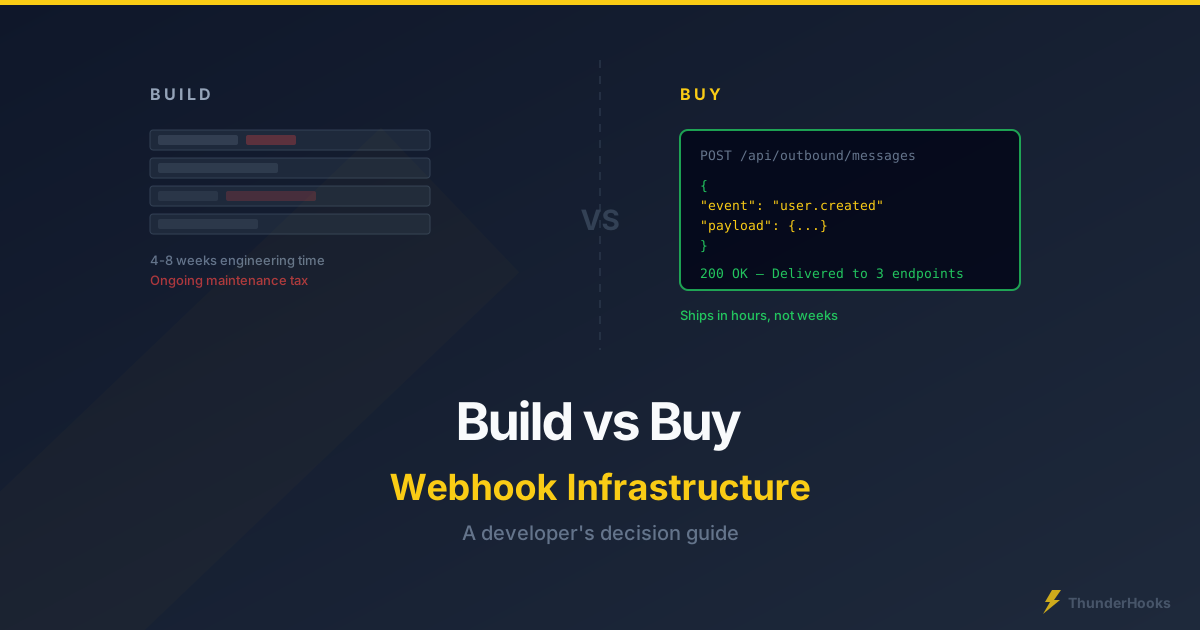
Build vs Buy Webhook Infrastructure: A Developer's Decision Guide
You need to send webhooks to your customers. The question isn't whether you need webhook delivery — it's whether you should build the infrastructure yourself or use a managed service.
Having built webhook delivery systems from scratch and also used managed services, here's an honest breakdown.
What "Building It Yourself" Actually Means
Most teams underestimate this. The initial implementation takes a weekend. Making it production-ready takes months.
The weekend version:
- An HTTP client that POSTs to customer URLs
- A database table storing events and delivery status
- Maybe a retry loop with
time.Sleep
The production version:
- Exponential backoff with jitter (not just
time.Sleep(attempt * 2)) - Circuit breakers per customer endpoint (stop hammering failing URLs)
- Dead letter queues for events that exhaust retries
- HMAC-SHA256 signature generation (customers need to verify it's really you)
- Idempotency handling (what happens when your delivery worker crashes mid-batch?)
- Rate limiting per destination (don't DDoS your own customers)
- Bounded concurrency (don't spawn 10,000 goroutines when a backlog builds up)
- Delivery logs with response bodies (for debugging)
- A dashboard for your team to monitor delivery health
- A portal for your customers to manage their endpoints
- Retention policies that clean up old delivery data
- DNS validation preventing SSRF attacks via webhook URLs
Each bullet point is a day or more of engineering time. The total is 4-8 weeks for a senior developer.
The Hidden Costs of Building
Maintenance Tax
Webhook infrastructure doesn't stop needing attention after launch. You'll spend ongoing time on:
- Investigating delivery failures ("why did Acme Corp's webhook stop working?")
- Scaling the delivery worker as volume grows
- Upgrading TLS/crypto libraries for security patches
- Handling edge cases you didn't anticipate (what if a customer's endpoint returns 301? 429? Takes 60 seconds to respond?)
- Building features customers ask for (event type filtering, secret rotation, delivery dashboards)
A rough estimate: 10-20% of one engineer's time, perpetually.
Opportunity Cost
Those 4-8 weeks of build time aren't free. They're weeks you're not spending on your core product — the thing your customers actually pay for.
If your SaaS charges $50/month and you have 100 customers, that's $5,000 MRR. A managed webhook service at $29-79/month is 0.6-1.6% of revenue. Building it yourself costs 1-2 months of an engineer's salary.
When Building Makes Sense
Building your own makes sense when:
-
You're at massive scale. If you're sending 100M+ webhooks per month, the economics of a managed service don't work. You need custom infrastructure tuned to your specific workload.
-
Webhook delivery is your core product. If you're literally building a webhook infrastructure company, you should own this.
-
You have strict compliance requirements. Some regulated industries require complete control over data flow, no third-party processors.
-
You have a team of infrastructure engineers with spare capacity. This is rare.
When Buying Makes Sense
Using a managed service makes sense when:
-
You're a startup or small team. Your engineering time is your most expensive resource. Don't spend it on plumbing.
-
You need it working this week. A managed service gets you from zero to production webhook delivery in hours, not weeks.
-
You want battle-tested reliability. Managed services have already handled the edge cases you haven't thought of yet.
-
You'd rather pay $29/month than build. The math is simple. $29/month vs 4-8 weeks of engineering time.
The Managed Service Landscape
| Service | Starting Price | Events Included | Key Differentiator |
|---|---|---|---|
| Svix | $490/month | 50,000 | Enterprise features, embeddable portal |
| Convoy | $99/month | Varies | Open-source, self-hosted option |
| Hookdeck | $10/million (PAYG) | Pay-as-you-go | Multi-destination (SQS, Kafka) |
| ThunderHooks | $29/month | 50,000 | Simplest setup, built-in monitoring |
The pricing range is wide. Svix targets enterprise ($490/mo minimum). Hookdeck does pure pay-as-you-go. ThunderHooks and Convoy target the middle market.
What to Look For in a Managed Service
Must-haves:
- HMAC signature generation (Standard Webhooks spec compliance)
- Automatic retries with exponential backoff
- Delivery logs with response bodies
- Event type filtering
- A dashboard to monitor delivery health
Nice-to-haves:
- Customer-facing portal (saves you building endpoint management UI)
- Circuit breakers (automatically pauses deliveries to failing endpoints)
- Dead letter queue management
- Multiple signing secrets for key rotation
Red flags:
- No retry customization
- No delivery logs
- Pricing that scales unpredictably
- No self-hosted option (vendor lock-in risk)
The Hybrid Approach
Some teams start with a managed service and migrate to self-hosted later if scale demands it. This is actually a solid strategy:
- Launch with a managed service ($29/month)
- Focus engineering time on your core product
- If you hit 1M+ events/month, evaluate whether to self-host
- By then, you've learned exactly what features you need
The webhook delivery system you build after 12 months of operating with a managed service will be 10x better than what you'd build on day one, because you'll know your actual requirements.
Conclusion
For most teams: buy. The math is clear. $29-79/month is cheaper than engineering time, and you get a battle-tested system immediately.
Build only if you're at massive scale, webhook delivery is your core product, or you have strict compliance requirements that prevent using third-party services.
The worst option is building a half-baked system that works 95% of the time but fails silently on the edge cases that matter most — like delivering a payment webhook to a customer who just signed up for your $10,000/year plan.
ThunderHooks provides outbound webhook delivery starting at $29/month with automatic retries, HMAC signing, circuit breakers, and a customer-facing portal. Start sending webhooks →